Bore Headworks: What Sits at the Top of a Commercial Bore and Why It Matters
Bore headworks is everything at the top of the bore that connects the pump below ground to the pipework above it. It seals the bore against contamination, carries the weight of the pump and rising main, and controls the water as it leaves the bore. On a commercial bore it also has to allow safe access for servicing and make room for a meter and monitoring. Get it right and the bore is easier to protect, test and maintain for its whole working life.
What bore headworks includes
Every site is different, but a commercial headworks is usually built from the same set of parts.
Casing top and seal
The bore casing finishes above ground, normally set in a concrete slab that sheds water away from it. A sealed cap or headplate closes the top so surface water, soil, insects and small animals cannot get into the bore. An open or poorly sealed casing is one of the easiest ways for a bore to become contaminated.
Pump support, rising main and cable
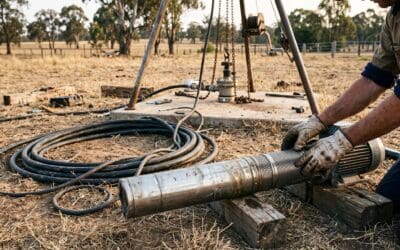
The submersible pump hangs on its rising main, and the headworks carries that load along with the column of water inside it. The power cable and any monitoring cables pass through sealed entries. On a local council project, Wallace Irrigation installed a 22kW Grundfos submersible bore pump on Crusader Hose, a hose known for its durability and performance under pressure. You can read more about that council bore pump installation in our recent work.
Delivery manifold and valves
The delivery manifold turns the water from vertical to horizontal and carries the valves that control it. A non-return valve stops water running back down the bore when the pump stops. An isolation valve lets the line be shut off for work, and an air release valve and pressure gauge are commonly fitted here too. On the same council job, the team used a 150mm stainless steel pump delivery manifold for robust support and flow control.
Meter and monitoring points
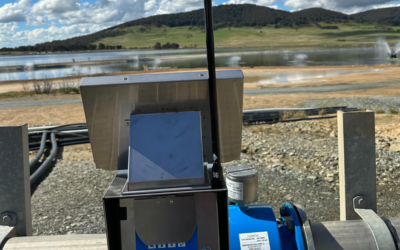
Many commercial bores also need a water meter on the delivery line. A meter needs a straight run of pipe to read accurately, so its position has to be allowed for when the headworks is laid out. A sampling tap for water quality and an access point for measuring the water level in the bore are just as useful. Both are needed when testing a bore’s yield and recovery, and both are far easier to include at the start than to add later.
Why the design matters for the life of the bore
Headworks is often treated as plumbing at the end of a pump job, but it decides how easy the bore is to look after for years afterwards.
- Protection: a sealed, raised headworks keeps contamination out of the bore and the water supply.
- Access: every pump eventually has to come out. Headworks built with lifting access and flanges in the right places makes pulling a bore pump for repair quicker and cheaper.
- Durability: stainless steel and quality fittings resist corrosion, which matters on bores with aggressive or iron-rich water.
- Information: a meter, a gauge and water level access give the readings that show when a pump or bore is starting to decline.
Headworks on mine and commercial sites
On mine sites and other busy commercial sites, headworks also has to survive the site around it. That can mean bollards or barriers against vehicles, lockable covers, and cable and pipe runs protected from traffic. Wallace Irrigation specialises in bore pump installation and site services for mining, and prepares a JSEA and SWMS before work starts so the site is ready and the job runs safely. Our overview of commercial and industrial bore pump installation covers the wider process.
If you are planning a new bore installation or your existing headworks needs work, call James Wallace on 0417 930 343 or get in touch through our contact page.